Monday, September 23, 2019

History of the British Isles


History of the British Isles

The British Isles have witnessed intermittent periods of competition and cooperation between the people that occupy the various parts of Great Britain, the Isle of ManIreland, the Bailiwick of Guernsey, the Bailiwick of Jersey and the smaller adjacent islands.
Today, the British Isles contain two sovereign states: the Republic of Ireland and the United Kingdom. There are also three Crown dependenciesGuernseyJersey and the Isle of Man. The United Kingdom comprises EnglandNorthern IrelandScotland, and Wales, each country having its own history, with all but Northern Ireland having been independent states at one point. The history of the formation of the United Kingdom is very complex.
The British monarch was head of state of all of the countries of the British Isles from the Union of the Crowns in 1603 until the enactment of the Republic of Ireland Act in 1949, although the term "British Isles" was not used in 1603. Additionally, since the independence of most of Ireland, historians of the region often avoid the term British Isles due to the complexity of relations between the peoples of the archipelago (see: Terminology of the British Isles).

Solar system

Solar System

planetary system of the Sun


Planets and dwarf planets of the Solar System. Compared with each other, the sizes are correct, but the distances are not
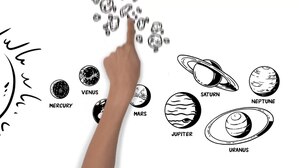
A simple video explanation of the Solar System
The Solar System is the Sun and all the objects that orbit around it. The Sun is orbited by planetsasteroidscomets and other things.
The Solar System is about 4.6 billion years old.[1] It formed by gravity in a large molecular cloud. Most of this matter gathered in the center, and the rest flattened into an orbiting disk that became the Solar System. It is thought that almost all stars form by this process.
The Sun is a star. It contains 99.9% of the Solar System's mass.[2] This means that it has strong gravity. The other objects are pulled into orbit around the Sun. The Sun is mostly made out of hydrogen, and some helium.
There are eight planets in the Solar System. From closest to farthest from the Sun, they are: MercuryVenusEarthMarsJupiterSaturnUranus and Neptune. The first four planets are called terrestrial planets. They are mostly made of rock and metal, and they are mostly solid. The last four planets are called gas giants. This is because they are much larger than other planets and are mostly made of gas.
The Solar System also contains other things. There are asteroids, mostly between Mars and Jupiter. Further out than Neptune, there is the Kuiper belt and the scattered disc. These areas have dwarf planets, including Pluto. There are thousands of very small objects in these areas. There are also comets, centaurs, and there is interplanetary dust.
Six of the planets and three of the dwarf planets are orbited by moons. Furthermore, planetary dust orbits the gas giants. Many other systems like the Solar System have been found. Each of the billions of stars in the Milky Way galaxy might have a planetary system